What Can You Do After DAE in Pakistan?
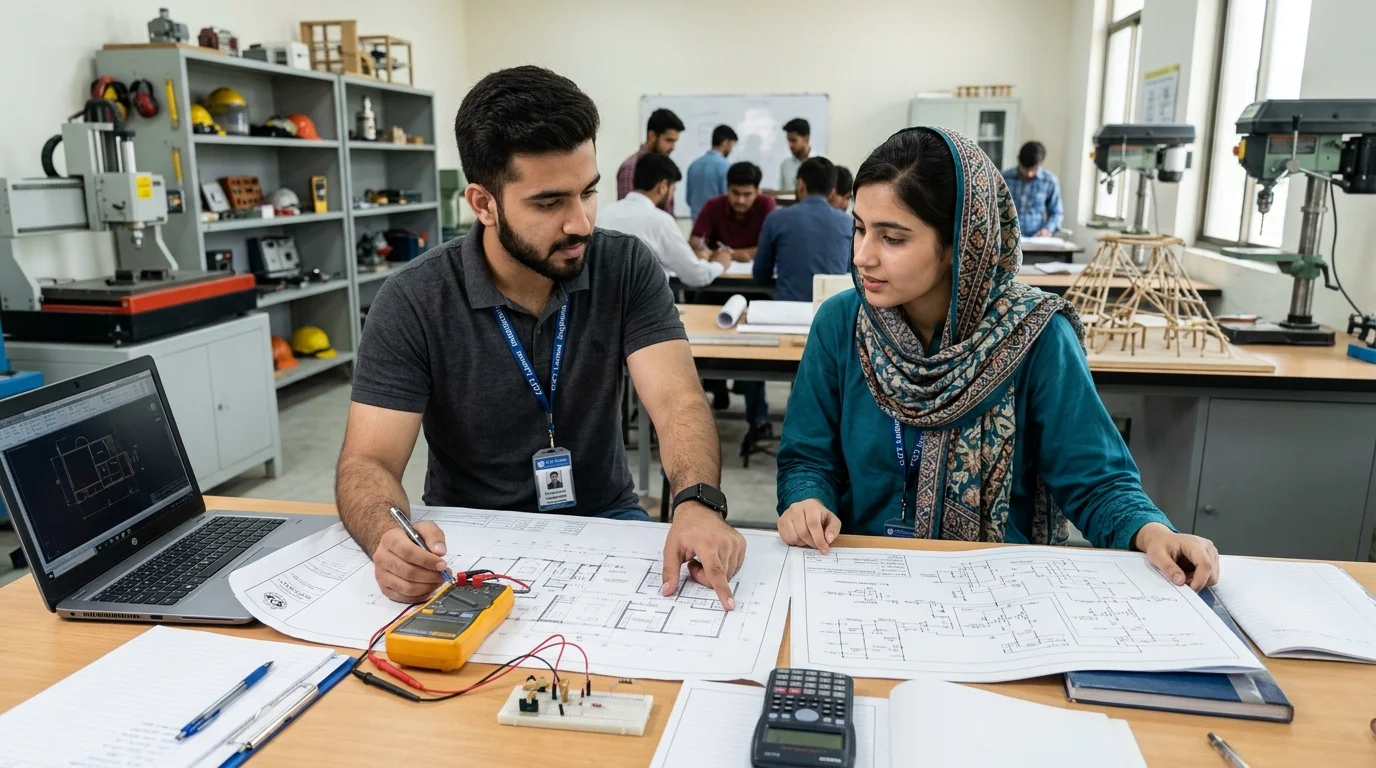
Completing a 3-year Diploma of Associate Engineer (DAE) from a recognized provincial Board of Technical Education (such as PBTE, SBTE, KP-BTE, or BTE Balochistan) is one of the most practical and industry-grounded educational accomplishments a Pakistani student can achieve. Unlike conventional intermediate programs (FSc, ICS, or FA) that emphasize abstract classroom theory, a DAE program immerses students directly into hands-on laboratory workshops, technical schematics, industrial machinery, and applied drafting from day one.
However, graduating with a DAE brings diploma holders to a pivotal crossroads. Broadly, DAE graduates face three distinct pathways:
- Continuing Higher Education (Bachelor's Degree Pathways): Pursuing a 4-year BS Engineering Technology program accredited by the National Technology Council (NTC), competing for reserved quota seats in B.E. / B.Sc Engineering accredited by the Pakistan Engineering Council (PEC), or exploring computing and applied management programs where institutional eligibility rules permit.
- Immediate Technical Employment & Industrial Progression: Entering the industrial workforce as a junior associate engineer, site supervisor, maintenance technician, CAD draftsman, or testing specialist, monetizing practical skills immediately and progressing through industry experience.
- International Higher Education & Overseas Technical Careers: Exploring bachelor-level technology studies abroad, specialized vocational polytechnic diplomas in countries like Germany, the UK, Australia, or Canada, or targeting skilled technician employment in the Gulf Cooperation Council (GCC) region.
No single direction is universally superior. The ideal choice depends fundamentally on your specific DAE discipline, your academic grades, your family's financial capacity, and whether your ultimate career ambition lies in frontline operational troubleshooting, executive engineering management, or international technological innovation.
---
Degree Options After DAE in Pakistan
Under regulations established by the Inter Board Coordination Commission (IBCC) and the Higher Education Commission (HEC), a 3-year DAE is recognized as equivalent to intermediate (12 years of education) for admission purposes into relevant higher education programs.
Today, DAE graduates have multiple legitimate degree avenues:
- 4-Year BS Engineering Technology (BSc / BS Tech): The primary academic continuation designed specifically for diploma holders. These 4-year honours programs (130–140 credit hours) are regulated and accredited by the National Technology Council (NTC) under the HEC.
- 4-Year B.E. / B.Sc Engineering (Reserved Quota Seats): Under statutory regulations of the Pakistan Engineering Council (PEC), recognized public engineering universities reserve a dedicated quota of seats (traditionally 2% to 5% of total capacity) for DAE holders in relevant disciplines.
- BS Computer Science / Software Engineering / Information Technology: Certain chartered universities admit DAE holders—particularly those from DAE Computer Information Technology (CIT), Electronics, or Telecommunication—into 4-year computing programs, subject to institutional math prerequisites and entry test clearance.
- BS Management & Applied Sciences: Fields such as BS Project Management, BS Construction Management, BS Supply Chain, and BBA are increasingly open to DAE graduates seeking to complement their technical background with commercial and leadership skills.
Crucial Eligibility Warning: Degree eligibility is never universal. It depends strictly on your specific DAE technology (e.g., Civil DAE cannot apply for Electrical Engineering), your intermediate board percentage (typically 50% minimum for BS Technology, 60%+ for B.E. quotas), and the current admission policy of the specific university. Always verify departmental eligibility before submitting non-refundable fees.
---
Which Degree Matches Your DAE Technology?
Aligning your undergraduate degree with your foundational DAE discipline is essential for credit recognition, licensing, and professional career progression. Below are the verified academic and professional pathways for major DAE disciplines:
1. DAE Civil Technology
Degree Areas to Explore: BS Civil Engineering Technology (NTC-accredited), B.E. Civil Engineering (PEC reserved quota), BS Construction Project Management, BS Urban Planning. Essential Skills to Develop: AutoCAD 2D/3D, Civil 3D, Revit Structure, Total Station surveying, GPS mapping, Primavera P6 / MS Project, quantity estimation, and bar bending schedule (BBS) preparation. Example Career Directions: Site supervision engineer, structural draftsman, quantity surveyor, highway construction technologist, land surveyor, building inspector. Important Eligibility Note: DAE Civil graduates are strictly eligible only for Civil Engineering / Technology and related construction programs; they cannot transition into electrical or mechanical degrees.
2. DAE Electrical Technology
Degree Areas to Explore: BS Electrical Engineering Technology (Power / Electronics), B.E. Electrical Engineering (PEC quota), BS Renewable Energy Technology, BS Telecommunication Technology. Essential Skills to Develop: Programmable Logic Controllers (PLC - Siemens, Delta), SCADA fundamentals, AutoCAD Electrical, single-line diagrams (SLD), industrial motor control wiring, power distribution switchgear, and solar PV system design. Example Career Directions: Substation operation technologist, industrial automation technician, power plant maintenance supervisor, electrical CAD designer, renewable energy installer. Important Eligibility Note: Electrical DAE is among the most versatile diplomas in Pakistan, with widespread eligibility across public utilities (WAPDA, K-Electric, NTDC) and industrial manufacturing plants.
3. DAE Mechanical Technology
Degree Areas to Explore: BS Mechanical Engineering Technology, B.E. Mechanical Engineering (PEC quota), BS Manufacturing Technology, BS Mechatronics Technology, BS Industrial Safety. Essential Skills to Develop: SolidWorks, Autodesk Inventor, CNC machine programming (G-code/M-code), pneumatic and hydraulic system troubleshooting, welding inspection (NDT basics), and preventive maintenance scheduling. Example Career Directions: Plant maintenance technologist, CNC machinist/programmer, quality assurance (QA/QC) inspector, production planning assistant, HVAC maintenance supervisor. Important Eligibility Note: Mechanical DAE graduates have priority access to heavy engineering, automotive manufacturing, fertilizer plants, and textile mills across Pakistan.
4. DAE Electronics & Mechatronics Technology
Degree Areas to Explore: BS Electronics Engineering Technology, BS Mechatronics Engineering Technology, BS Embedded Systems, BS Telecommunication Technology. Essential Skills to Develop: Printed Circuit Board (PCB) design (Proteus, Altium Designer), microcontroller programming (Arduino, ESP32, STM32), industrial instrumentation, sensor interfacing, and robotics automation. Example Career Directions: Automation technician, biomedical equipment maintenance technologist, telecom cell site engineer, embedded systems developer, IoT hardware technician. Important Eligibility Note: Students with strong programming aptitude can often bridge into IoT and industrial automation systems with high corporate demand.
5. DAE Computer Information Technology (CIT) / Computer Technology
Degree Areas to Explore: BS Computer Engineering Technology (NTC), BS Software Engineering, BS Computer Science (subject to university-specific admission criteria), BS Information Technology, BS Cyber Security. Essential Skills to Develop: Python, JavaScript, Linux system administration, Cisco Certified Network Associate (CCNA) routing & switching, database management (SQL), and cloud infrastructure fundamentals. Example Career Directions: Network administrator, junior software developer, cybersecurity support specialist, IT infrastructure coordinator, web applications developer. Important Eligibility Note: While NTC-accredited BS Computer Engineering Technology accepts DAE CIT directly, admission into NCEAC-accredited BS Computer Science varies by university. Always verify whether the university requires an FSc mathematics deficiency course.
6. DAE Auto & Diesel / Automotive Technology
Degree Areas to Explore: BS Automotive Engineering Technology, BS Mechanical Engineering Technology, BS Thermal Power. Essential Skills to Develop: Electronic Fuel Injection (EFI) diagnostics, computerized scanning tools (OBD-II), hybrid and electric vehicle (EV) battery systems, engine overhaul procedures, and automotive CAD drafting. Example Career Directions: Dealership workshop supervisor, fleet maintenance manager, automotive diagnostic specialist, quality control inspector in assembly plants (Indus Motor, Honda, Pak Suzuki). Important Eligibility Note: The rapid emergence of electric vehicles (EVs) in Pakistan is creating a high-value niche for technicians skilled in both mechanical engines and battery electronic management.
7. DAE Refrigeration & Air Conditioning (RAC / HVAC)
Degree Areas to Explore: BS Mechanical Engineering Technology (HVAC Specialization), BS Energy Systems. Essential Skills to Develop: Psychrometric chart analysis, cooling load calculation software (HAP - Hourly Analysis Program), duct design & sizing, Variable Refrigerant Flow (VRF) installation, and central chiller maintenance. Example Career Directions: Central HVAC plant supervisor, commercial refrigeration technician, MEP drafting technologist, building automation specialist. Important Eligibility Note: RAC specialists with international certifications (such as ASHRAE or EPA) command some of the highest technical salaries across Gulf countries (UAE, Saudi Arabia, Qatar).
---
Engineering vs Engineering Technology: Understanding the Difference
One of the most frequent points of confusion among DAE students in Pakistan is the distinction between a Bachelor of Engineering (B.E. / B.Sc Engineering) and a Bachelor of Science in Engineering Technology (BS / B.Sc Engineering Technology).
To make an informed decision, students must understand that these are distinct, complementary qualifications designed for different segments of the technological workforce:
| Dimension | Engineering (B.E. / B.Sc Engg) | Engineering Technology (BS / BSc Tech) |
|---|---|---|
| Statutory Regulatory Body | Pakistan Engineering Council (PEC) | National Technology Council (NTC) under HEC |
| Academic & Curriculum Focus | Advanced mathematical modeling, conceptual scientific theory, research, and design of new systems | Practical implementation, operational application, fabrication, commissioning, testing, and maintenance |
| Laboratory / Practical Ratio | Typically 70% theoretical lecture / 30% laboratory experiments | Typically 50% theoretical lecture / 50% practical hands-on application |
| Senior Industrial Internship | Standard 6 to 8-week summer internship | Extensive 16 to 30-week (up to two full semesters) supervised industrial training |
| Professional Licensing Title | Registered Engineer (RE) / Professional Engineer (PE) | Registered Engineering Technologist / Professional Engineering Technologist |
| Typical Career Environment | Conceptual design office, engineering consultancy, R&D laboratories, simulation modeling | Factory floor, construction site, operations & maintenance, industrial commissioning, plant supervision |
| Primary DAE Route | Limited reserved quota seats (highly competitive, requires ECAT/entry test) | Open, direct admission designed specifically for DAE diploma holders |
Neither degree is universally superior to the other. In a modern power plant or construction project, the Professional Engineer designs the conceptual structural calculations, while the Professional Engineering Technologist supervises the precision fabrication, ensures field compliance, troubleshoots mechanical failures, and executes commissioning.
---
DAE to BS Engineering Technology: Programs & NTC Accreditation
The 4-Year Bachelor of Science in Engineering Technology (BS ET) is the premier higher education pathway for DAE graduates in Pakistan. Following reforms by the Higher Education Commission, the older 2-year B.Tech Pass and B.Tech Honours titles have been consolidated into standardized 4-year BS Engineering Technology degrees.
Why NTC Accreditation is Non-Negotiable
The National Technology Council (NTC) is the autonomous statutory accreditation authority established under HEC to regulate higher education in engineering technology disciplines.
Before enrolling in any university offering BS Engineering Technology, students must verify that the specific program and university batch are officially accredited by NTC. Enrolling in an unaccredited engineering technology program means: You will not be registered as a Professional Engineering Technologist with NTC. You may face disqualification when applying for technical government posts (BPS-17 Assistant Director / Sub-Divisional Officer). * Foreign credential assessment bodies (such as Engineers Australia or Sydney Accord signatories) will not recognize your degree for international skilled migration.
Prominent public and chartered institutions offering NTC-accredited programs include University of Technology (UOT) Nowshera, Punjab Tianjin University of Technology (PTUT) Lahore, Balochistan UET Khuzdar, NFC Institute of Engineering & Technology Multan, Superior University Lahore, and Mirpur University of Science and Technology (MUST).
---
Can DAE Students Enter Engineering Programmes? (PEC Quotas & Rules)
The short answer is yes, but with strict limitations and severe competition.
Under Pakistan Engineering Council (PEC) regulations, recognized engineering universities in Pakistan are authorized to reserve a small percentage of their total undergraduate seats (typically 2% to 5%) for candidates holding a relevant DAE diploma.
What You Need to Qualify for a B.E. / B.Sc Engineering Seat:
1. Strict Discipline Matching: A DAE Civil can only compete for Civil Engineering; a DAE Electrical can only compete for Electrical Engineering; a DAE Mechanical can only compete for Mechanical Engineering. No stream crossing is permitted under PEC rules. 2. High Academic Merit (Typically 65%–75%+): Because only 2 to 5 seats are typically reserved per engineering department, the merit cut-off for DAE holders is extraordinarily competitive, often exceeding the merit of open intermediate candidates. 3. Mandatory Provincial Entry Tests: DAE candidates must appear in and pass the competitive engineering entrance test of their respective province: ECAT conducted by UET Lahore (Punjab) NED Entry Test / DUET Test (Sindh) ETEA Engineering Test (Khyber Pakhtunkhwa) Provincial university entrance tests in Balochistan and Azad Kashmir. 4. IBCC Equivalence Certificate: Candidates must obtain an official FSc Pre-Engineering Equivalence Certificate from the Inter Board Coordination Commission (IBCC) verifying their DAE marks.
If you score high marks in your DAE and prepare systematically for the provincial engineering entrance test, securing a reserved PEC engineering seat at an institution like UET Lahore, NED Karachi, or UET Peshawar is an outstanding achievement. However, because seats are limited, DAE students must always prepare a parallel backup application in an NTC-accredited BS Engineering Technology program.
---
Degree or Job After DAE? (The Decision Matrix)
One of the most consequential dilemmas facing every DAE graduate is whether to continue full-time studies or immediately step into the industrial job market.
Consider this structured decision matrix:
| Factor | Route A: Continue Higher Education (BS) | Route B: Immediate Technical Employment | Route C: Work + Evening Degree (Hybrid) |
|---|---|---|---|
| Financial Horizon | Requires 4 years of tuition and living support; no immediate income | Immediate monthly salary; relieves family financial pressure | Modest technician salary while self-funding evening/weekend university tuition |
| Career Ceiling | High: Eligible for BPS-17 government posts, executive management, and international Master's degrees | Limited: Technicians without a 16-year BS degree often hit a career ceiling after 5–8 years | High: Combines 4 years of real industrial experience with an accredited 16-year bachelor's degree |
| Practical Skill Acquisition | Advanced theoretical modeling, project management, and specialized simulations | Daily hands-on troubleshooting, industrial machinery operation, site mastery | Maximum practical mastery, but demands exceptional personal discipline and stamina |
| Ideal Student Profile | Top academic achievers with financial support aiming for corporate management or overseas MS | Students needing immediate financial self-sufficiency or who prefer hands-on machinery | Determined students near major industrial hubs (Karachi, Lahore, Faisalabad, Taxila) |
Strategic Advice:
If your family's financial circumstances allow, pursuing an accredited 4-year BS Engineering Technology degree elevates your lifetime earnings and opens senior executive roles that are permanently closed to diploma-only holders. If immediate employment is necessary, seek opportunities with established industrial firms and explore HEC/NTC-approved evening or weekend degree programs after your first year on the job.
---
Career Directions & Industrial Roles After DAE
Pakistan's industrial sector relies heavily on Associate Engineers to bridge the gap between abstract design blueprints and operational factory machinery. Depending on your specialization, typical entry-level and mid-career positions include:
- Site Supervision & Construction Management: Monitoring civil structural pours, verifying reinforcement bar placement, conducting concrete slump tests, and ensuring workplace safety compliance on infrastructure projects.
- Electrical Substation & Grid Maintenance: Managing high-voltage switchgear, executing transformer maintenance protocols, testing circuit breakers, and monitoring power factor panels.
- Industrial Automation & PLC Operation: Programming automated assembly lines, troubleshooting pneumatic actuators, calibrating sensors, and maintaining SCADA control terminals in chemical, pharmaceutical, and textile plants.
- Plant Maintenance & Reliability: Performing preventive, predictive, and corrective maintenance on centrifugal pumps, air compressors, steam boilers, and mechanical gearboxes.
- Computerized Numerical Control (CNC) Machining: Writing G-code programs, setting up multi-axis CNC milling machines, and verifying mechanical part tolerances using precision micrometers and vernier calipers.
- Heating, Ventilation & Air Conditioning (HVAC): Operating central chilled water plants, balancing airflow distribution systems, and servicing rooftop package units in commercial high-rises and hospitals.
- Quality Assurance & Inspection (QA/QC): Utilizing Non-Destructive Testing (NDT) methodologies, checking welding seams, and documenting compliance with ISO 9001 and industrial safety protocols.
(Note: These roles serve as illustrative industrial examples; actual appointments and compensation depend on technical competence, employer scale, and economic conditions).
---
Skills That Strengthen a DAE Profile
A diploma certificate alone will not guarantee high-paying technical employment. Employers in Pakistan and the Gulf actively seek candidates who possess verifiable proficiency in industry-standard software tools and practical operational competencies:
- Computer-Aided Drafting & Modeling (CAD/CAM): AutoCAD (2D/3D), SolidWorks, Autodesk Revit, and Civil 3D. The ability to read, interpret, and modify complex engineering drawings is mandatory across all technical sectors.
- Industrial Automation & Electronics: Hands-on ladder logic programming for Siemens S7-1200 / Delta PLCs, VFD (Variable Frequency Drive) parameter configuration, and sensor wiring.
- Project Planning & Quantity Software: Primavera P6, Microsoft Project, and advanced Microsoft Excel for bill of quantities (BOQ) preparation, rate analysis, and project scheduling.
- Occupational Health, Safety & Environment (HSE): International certifications such as NEBOSH (IGC), IOSH Managing Safely, or OSHA. Certified safety officers command significant salary premiums on oil & gas, construction, and manufacturing sites.
- Digital Communication & Technical Documentation: Clear English report writing, maintenance logbook auditing, email etiquette, and client presentation abilities.
---
Comprehensive DAE Technology-to-Degree Matrix
The table below illustrates verified academic continuation pathways across major DAE disciplines in Pakistan:
| DAE Technology | Relevant Degree Areas to Explore | High-Value Practical Skills | Example Industrial Career Directions | Eligibility & Recognition Check |
|---|---|---|---|---|
| Civil | BS Civil Engineering Technology, B.E. Civil (PEC Quota), BS Construction Management | AutoCAD Civil 3D, Total Station, Primavera P6, Quantity Surveying | Site supervisor, quantity surveyor, structural draftsman, highway technologist | Restricted strictly to Civil discipline; verified under NTC and PEC quotas |
| Electrical | BS Electrical Engineering Technology, B.E. Electrical (PEC Quota), BS Renewable Energy | PLC / SCADA, AutoCAD Electrical, Motor Control Wiring, Solar PV Design | Substation technologist, industrial electrician, automation technician, solar designer | Open across power distribution, manufacturing plants, and utilities (WAPDA/KE) |
| Mechanical | BS Mechanical Engineering Technology, B.E. Mechanical (PEC Quota), BS Manufacturing | SolidWorks, CNC G-Code, Welding Inspection, Boiler/Pump Maintenance | Plant maintenance technologist, CNC programmer, QA/QC inspector, piping draftsman | High demand across heavy engineering, fertilizer, textile, and auto plants |
| Electronics | BS Electronics Engineering Technology, BS Mechatronics, BS Telecommunication | PCB Design (Proteus/Altium), Microcontrollers (Arduino/ESP32), Instrumentation | Automation technician, biomedical maintenance technologist, cell site engineer | Interdisciplinary eligibility bridging into IoT and industrial robotics systems |
| Computer (CIT) | BS Computer Engineering Technology, BS Software Engineering, BS IT, BS Cyber Security | Python, CCNA Networking, Linux Server Admin, SQL Database Management | Network administrator, junior software developer, IT support coordinator | Verify whether target university requires FSc Mathematics deficiency course |
| Auto & Diesel | BS Automotive Engineering Technology, BS Mechanical Engineering Technology | EFI Computerized Diagnostics, OBD-II Scanning, EV Battery Systems, Engine Overhaul | Dealership workshop supervisor, fleet maintenance manager, testing technologist | High future growth in hybrid and electric vehicle (EV) maintenance sectors |
| RAC / HVAC | BS Mechanical Engineering Technology (HVAC Specialization), BS Energy Systems | Psychrometric Analysis, Cooling Load Calculation (HAP), Chiller Maintenance | Central HVAC plant supervisor, MEP drafting assistant, refrigeration specialist | High salary premium across UAE, Saudi Arabia, and Qatar commercial projects |
---
Study Abroad After DAE: Feasible Pathways & Realities
Many DAE graduates aspire to study abroad but are misled by unauthorized visa agents claiming that a 3-year diploma guarantees direct, unconditional entry into foreign Master's or Engineering degrees.
To navigate international education safely, DAE holders must understand the verified statutory realities:
- Qualification Equivalence (12-Year vs 13-Year Systems): In most Commonwealth and European countries (such as the UK, Germany, and Australia), direct admission into a standard 3-year or 4-year Bachelor of Engineering (B.Eng / B.Sc) requires 13 years of preparatory schooling (such as British A-Levels). Because a Pakistani DAE represents 12 years of formal education, students generally enter through a 1-Year International Foundation Programme (IFY) in Engineering or (in Germany) a preparatory Studienkolleg (T-Kurs) before joining the Bachelor's degree.
- Applied Universities & Polytechnic Institutes: Universities of Applied Sciences (Fachhochschulen in Germany, Institutes of Technology in Ireland, TAFE institutes in Australia, and Technical Colleges in Canada) are ideal destinations for DAE holders. These institutions prioritize practical laboratory training and industrial internships over abstract theoretical physics.
- Mandatory English Language Proficiency: You must demonstrate verified English communication. Universities typically require IELTS Academic (minimum overall score of 6.0, with no individual band below 5.5) or equivalent scores in PTE Academic or TOEFL iBT.
- Transparent Financial Documentation: Visas require documented financial capacity (such as a 28-day bank statement for the UK or a blocked bank account of approximately €11,904 for Germany) to prove you can support your tuition and living expenses abroad.
- Explore Official Resources on Our Platform:
- * Review global country requirements on our Study Destinations portal.
- * Explore legitimate government and university scholarships on our International Scholarships directory.
- * Prepare systematically for your language requirements with our Language Test Preparation guide.
- * Evaluate your international admission and visa profile for free via our Free Visa Assessment tool.
- * Schedule a personalized strategy session with our senior advisors on our Book Consultation page.
Integrity Advisory: Never trust agents promising "study abroad with no bank statement", "guaranteed work visas", or "direct engineering master's without a bachelor's degree". Legitimate foreign universities require verified academic transcripts from technical boards, IBCC equivalence, and verifiable financial standing.
---
Pakistan or Study Abroad After DAE?
Choosing whether to pursue your bachelor's degree locally in Pakistan or venture abroad requires balancing several objective factors:
- Tuition & Living Expenses: Completing an NTC-accredited BS Engineering Technology in Pakistan costs approximately PKR 400,000 to PKR 1,200,000 across 4 years in reputable public or chartered private universities. Studying abroad typically requires PKR 3,500,000 to PKR 8,000,000+ per year in tuition and living costs unless supported by competitive merit scholarships.
- Degree Recognition & Licensing: A local degree accredited by NTC or PEC guarantees immediate licensing and eligibility for Pakistani public sector jobs (WAPDA, NESPAK, SNGPL, Civil Works). A foreign degree must undergo formal equivalence evaluation by HEC upon return to Pakistan.
- Career Objectives: If your goal is international technical migration, working in multinational engineering consortia, or settling in countries facing skilled technical labor shortages (such as Germany, Australia, or Canada), studying abroad provides superior post-study work visa rights and direct exposure to global technology standards.
---
Which Path Fits Your DAE Profile? (5 Practical Archetypes)
To clarify your decision, identify which practical student archetype matches your personality and circumstances:
Profile A: The Field Builder (Civil DAE + Infrastructure Focus)
Student Reality: Passionate about large-scale construction, structural surveying, and site execution. Enjoys outdoor field environments rather than sitting at a desk all day. Recommended Academic Route: BS Civil Engineering Technology (NTC-accredited) or prepare for B.E. Civil reserved quota seats. Skill Focus: AutoCAD Civil 3D, Total Station surveying, Primavera P6, concrete technology testing. Target Ambition: Construction site manager, structural inspector, infrastructure contractor.
Profile B: The Automation Strategist (Electrical/Electronics DAE + Industrial Focus)
Student Reality: Fascinated by automated machinery, industrial control panels, PLC circuits, and power distribution systems. Recommended Academic Route: BS Electrical / Mechatronics Engineering Technology. Skill Focus: PLC ladder programming (Siemens/Delta), SCADA, industrial motor wiring, variable frequency drives (VFDs). Target Ambition: Automation engineer, substation operations supervisor, power generation technologist.
Profile C: The Manufacturing Specialist (Mechanical DAE + Hands-on Focus)
Student Reality: Loves mechanical engines, manufacturing precision, CNC tooling, and troubleshooting industrial rotating machinery. Recommended Academic Route: BS Mechanical Engineering Technology or immediate technical employment with concurrent evening study. Skill Focus: SolidWorks 3D, CNC G-code programming, hydraulic systems, vibration analysis. Target Ambition: Plant maintenance manager, CNC workshop director, QA/QC mechanical inspector.
Profile D: The Digital Technologist (Computer/CIT DAE + Tech Focus)
Student Reality: Prefers software coding, networking cables, server administration, and cybersecurity protocols over physical machinery. Recommended Academic Route: BS Computer Engineering Technology, BS Software Engineering, or BS Cyber Security (subject to university mathematics eligibility). Skill Focus: Python, CCNA networking, Linux server administration, cloud fundamentals (AWS/Azure). Target Ambition: Network infrastructure administrator, junior DevOps engineer, systems analyst.
Profile E: The Global Explorer (DAE Holder Targeting International Education)
Student Reality: Strong English communication skills, solid academic record (65%+), and family financial capability to support international foundation or applied bachelor's studies. Recommended Academic Route: 1-Year International Foundation Year in Engineering/Technology in the UK, Australia, or Germany (Studienkolleg T-Kurs). Skill Focus: IELTS Academic (6.0+), advanced mathematics, technical English reporting. Target Ambition: International Professional Technologist, global skilled migration.
---
Common Mistakes DAE Students Make
Every academic cycle, hundreds of DAE graduates make critical missteps that delay their professional growth. Avoid these widespread errors:
- Confusing Engineering with Engineering Technology: Enrolling in an Engineering Technology program under the false impression that it will grant a PEC license as a Professional Engineer. Understand that NTC regulates Engineering Technology, while PEC regulates Engineering.
- Ignoring NTC Accreditation: Paying significant private university tuition for a BS Technology program that lacks official accreditation from the National Technology Council, rendering the degree unlicensable.
- Assuming Universal Eligibility: Believing that holding any DAE diploma qualifies you for any university degree. Academic disciplines must match, and university-specific math prerequisites must be fulfilled.
- Relying Solely on Diploma Marks Without Software Mastery: Graduating with an 80% DAE score but unable to operate basic AutoCAD, SolidWorks, or Microsoft Excel. In the modern technical sector, software competence is non-negotiable.
- Enrolling in Short Unaccredited Courses Instead of a Formal Degree: Spending substantial money on non-degree diploma academies claiming to offer "equivalencies" to university degrees. Short certificates complement a degree; they never replace one.
- Following Friends Blindly Without a Personal Career Plan: Choosing a field or entering an industrial plant simply because classmates did so, without assessing your individual aptitude, financial stamina, and long-term goals.
---
How to Choose Your Path After DAE — 6-Step Decision Framework
Follow this structured, 6-step framework to navigate your post-DAE transition with clarity:
- Step 01 — Identify Your DAE Technology & Practical Strengths: Review your 3-year board transcript. Identify the specific workshop subjects, laboratory experiments, and drafting assignments where you achieved your highest technical proficiency.
- Step 02 — Decide Your Long-Term Career Direction: Do you want to remain in hands-on frontline industrial operations, transition into corporate engineering management, or pursue international technological research?
- Step 03 — Compare Degree vs Employment Realities: Evaluate your family's financial capacity objectively. If full-time study is feasible, prioritize an accredited BS degree. If working is necessary, explore evening/weekend technology programs.
- Step 04 — Verify University Programme Eligibility & Quota Seats: If targeting B.E. Engineering, check PEC reserved seat numbers and entry test dates (ECAT/NED/ETEA). If targeting BS Engineering Technology, confirm matching technology eligibility.
- Step 05 — Check NTC / PEC / HEC Recognition: Verify that your target university, department, and specific program batch are officially accredited on the official NTC or PEC online portals before submitting non-refundable fees.
- Step 06 — Build Primary + Backup Pathways: Never rely on a single admission application. If applying for competitive B.E. quota seats, always maintain a parallel application in an NTC-accredited BS Technology program.
---
A Note for Parents of DAE Students
In Pakistani society, parents frequently misunderstand technical education, erroneously believing that because a student did not pursue FSc Pre-Engineering, their future is somehow restricted.
Contemporary industrial realities demonstrate the exact opposite: A 3-year DAE provides structured, practical technical competence that conventional intermediate students completely lack. While FSc graduates know theoretical physics formulas on paper, DAE graduates understand how to read an architectural schematic, operate a lathe, wire a distribution panel, and troubleshoot a hydraulic pump. In Pakistan's expanding manufacturing, energy, construction, and CPEC-related industrial zones, employers consistently report shortages of skilled, hands-on technologists. * Support your child's chosen specialization. Encourage them to pursue an accredited 4-year BS Engineering Technology degree or develop certified digital skills (CAD/PLC), rather than pressuring them into theoretical disciplines disconnected from their practical talents.
---
Still Confused About Your Career Direction After DAE?
Deciding between immediate technical employment, a 4-year BS Engineering Technology program, competing for PEC engineering quota seats, or exploring international education is a major life decision.
At Student Visa Guide, our senior education strategists and technical career advisors provide personalized, profile-based evaluations. We analyze your DAE technology, board marks, financial circumstances, and career ambitions to formulate a clear, realistic road map.
You can visit our main advisory center in Karachi for an in-person consultation: Office Address: Plot C-117, 2nd Floor, Phase-1, DHA, Karachi, Pakistan Online Consultations: Available nationwide across all cities of Pakistan via Zoom and Google Meet.
Explore our dedicated Career Counselling in Karachi portal to schedule an appointment with an experienced higher education advisor.